If your bathroom has no fan, you are not alone. Thousands of older homes across Oshawa and Durham Region were built without any mechanical ventilation in the bathroom. While it may seem like a small oversight, a missing exhaust fan can lead to serious moisture problems, mould growth, and even structural damage over time. Below, we break down why so many bathrooms lack fans, what the Ontario Building Code says today, and the practical solutions that keep your home healthy and dry.
Why So Many Oshawa Bathrooms Have No Fan

Durham Region is full of character homes built in the 1950s, 1960s, and 1970s. During those decades, the provincial building code did not require mechanical ventilation in bathrooms as long as the room had an operable window. Builders took the cheapest route and simply installed a small window above the tub or beside the toilet.
The logic made sense at the time: open the window and steam escapes. In practice, however, homeowners rarely open that window in a Canadian winter when it is minus-20 outside. The result is warm, humid air sitting in the room with nowhere to go.
Other common reasons a bathroom might not have a fan include:
- Cost-cutting during construction — Ventilation ductwork adds labour and material costs that some builders skipped.
- Renovations that bypassed permits — A DIY bathroom refresh may not have addressed mechanical systems.
- Converted spaces — Basements and closets turned into half-baths often lack any duct access to the exterior.
- Disconnected or broken fans — Some homes had fans originally, but previous owners removed or disconnected them during remodelling.
Ontario Building Code Requirements for Bathroom Ventilation
The current Ontario Building Code (OBC) is clear: every bathroom in a new build or major renovation must have mechanical ventilation that exhausts air directly to the outdoors. A window alone no longer satisfies the code for new construction.
Key points from the OBC and supplementary standards:
- Exhaust fans must vent to the outside — not into an attic, soffit, or crawl space.
- The fan must move at least 50 cubic feet per minute (CFM) for a standard bathroom.
- Ductwork should be insulated where it passes through unheated spaces to prevent condensation.
- If you renovate a bathroom down to the studs, you are generally required to bring ventilation up to current code.
If your home was built before these rules took effect and you have not done a major renovation, you are not technically in violation. However, the health and moisture risks still apply, and adding ventilation is one of the smartest upgrades you can make.
Health and Moisture Risks of a Bathroom Without a Fan
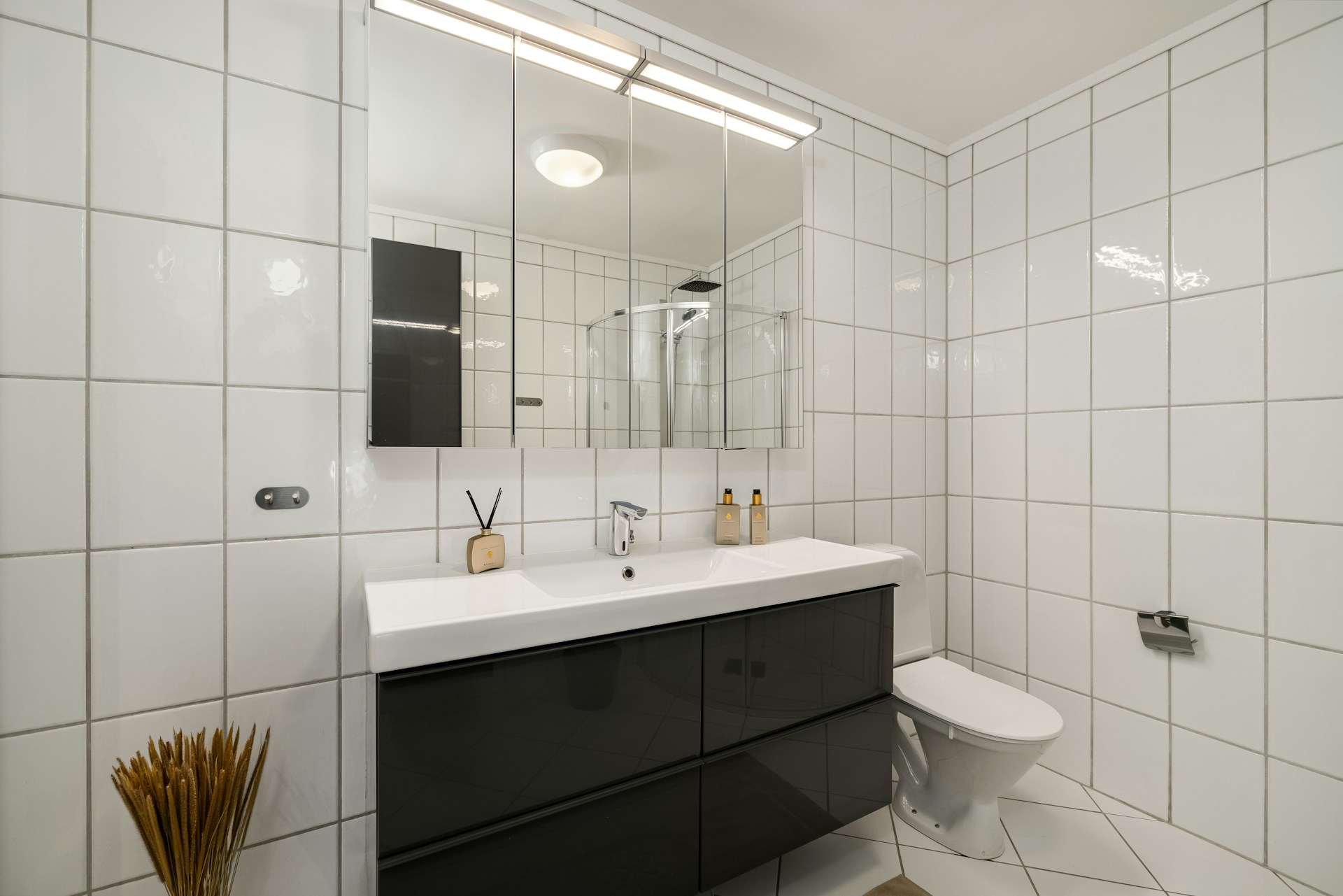
Every shower produces roughly 0.5 litres of moisture. Without an exhaust fan, that moisture settles on walls, ceilings, grout lines, and fixtures. Over weeks and months, the consequences add up:
- Mould and mildew — Black mould thrives in warm, damp environments. It can grow behind drywall, under flooring, and inside vanity cabinets where you cannot see it.
- Peeling paint and bubbling drywall — Excess humidity breaks down paint adhesion and causes drywall tape to separate.
- Warped trim and cabinetry — Wood absorbs moisture and swells, leading to warped door frames, baseboard separation, and cabinet damage.
- Respiratory issues — Mould spores in the air can trigger allergies, asthma, and other respiratory conditions, especially in children and seniors.
- Structural rot — In the worst cases, prolonged moisture penetration leads to rotting floor joists, wall studs, and subfloor sheathing.
If you already notice dark spots on the ceiling, a persistent musty smell, or paint peeling near the shower, moisture damage is likely underway. Acting sooner rather than later saves thousands of dollars in repair costs.
Solutions When Your Bathroom Has No Fan
The good news is that adding ventilation to an existing bathroom is straightforward for a qualified plumber or contractor. Here are the most common options ranked from most effective to supplementary:
1. Install a Ceiling-Mounted Exhaust Fan
This is the gold-standard solution. A licensed tradesperson cuts an opening in the ceiling, installs the fan housing, runs insulated ductwork to an exterior wall or roof cap, and connects the wiring. Modern exhaust fans are quiet (under 1.0 sone), energy-efficient, and some include humidity sensors that turn the fan on automatically when moisture levels rise.
Cost estimate: $400 to $900 installed, depending on duct run length and ceiling access.
2. Wall-Mounted Exhaust Fan
If ceiling access is limited — common in apartments and basement bathrooms — a wall-mounted fan vents directly through the exterior wall. Installation is faster because the duct run is minimal.
Cost estimate: $300 to $700 installed.
3. Inline Fan System
For bathrooms far from an exterior wall, an inline fan sits in the attic or between floors and pulls air through ductwork connected to a ceiling grille. This option works well when you want to ventilate multiple bathrooms with a single fan unit.
Cost estimate: $600 to $1,200 installed.
4. Supplementary Options
While not a replacement for mechanical exhaust, these measures help reduce moisture between showers:
- Portable dehumidifier — Pulls moisture from the air. Useful as a stopgap but requires emptying the reservoir regularly.
- Window ventilation — If you have a window, crack it open for 15 to 20 minutes after every shower, even in winter.
- Moisture-absorbing products — DampRid and similar products help in small, enclosed spaces like closets but are not a long-term bathroom solution.
During a bathroom renovation, adding an exhaust fan is the perfect time to address ventilation because walls and ceilings are already open. If you are planning an accessible bathroom renovation, proper ventilation is especially important because barrier-free showers produce more ambient moisture than enclosed tub-shower combos.
When to Call a Plumber About Bathroom Ventilation

You should call a professional if:
- You see visible mould on walls, ceiling, or grout that keeps returning after cleaning.
- Your bathroom mirror stays fogged for more than 10 minutes after a shower.
- Paint is peeling or drywall feels soft near the shower or tub area.
- You smell a persistent musty or earthy odour in the room.
- You are planning any bathroom renovation and want to bring ventilation up to code.
A plumber who also handles bathroom renovations — like Hayes Plumbing — can assess your ductwork options, recommend the right fan capacity, and ensure the installation meets Ontario Building Code standards. Brian Hayes and our team have over 45 years of experience solving ventilation and moisture problems in Durham Region homes.
Frequently Asked Questions

Is it legal to have a bathroom without a fan in Ontario?
If your home was built before the Ontario Building Code required mechanical ventilation and you have not done a major renovation, you are not violating the code. However, any new construction or significant bathroom renovation must include an exhaust fan that vents to the outside. Regardless of legality, adding a fan is strongly recommended for your health and your home’s longevity.
Can I vent a bathroom fan into the attic?
No. The Ontario Building Code requires exhaust fans to vent directly to the outdoors through a wall cap or roof cap. Venting into an attic traps moisture, which leads to mould on roof sheathing, wet insulation, and potential structural damage. If your current fan exhausts into the attic, have a professional extend the ductwork to an exterior termination point.
How much does it cost to add an exhaust fan to an existing bathroom?
Most bathroom exhaust fan installations in Durham Region cost between $400 and $900, including the fan unit, ductwork, exterior cap, and labour. Wall-mounted fans on exterior walls are on the lower end. Longer duct runs through attics or between floors cost more. During a full bathroom renovation, the cost is often lower because walls and ceilings are already open.
What size exhaust fan do I need for my bathroom?
The general rule is 1 CFM per square foot of bathroom floor area, with a minimum of 50 CFM. A standard 5-by-8-foot bathroom needs a 50 CFM fan. Larger bathrooms, or those with a jetted tub or steam shower, may need 80 to 150 CFM. Your installer can calculate the exact requirement based on your room dimensions and fixtures.
Does a bathroom fan help with mould?
Yes. An exhaust fan is the single most effective way to prevent bathroom mould. By removing humid air within minutes of a shower, the fan keeps surfaces dry and denies mould the moisture it needs to grow. For best results, run the fan during your shower and for at least 20 minutes afterward.
If your bathroom has no fan and you are dealing with moisture, mould, or peeling paint, the fix is simpler and more affordable than most homeowners expect. Contact Hayes Plumbing at (905) 576-3043 or visit our contact page for a free estimate. Serving Oshawa, Whitby, Ajax, Pickering, Clarington, and all of Durham Region.